
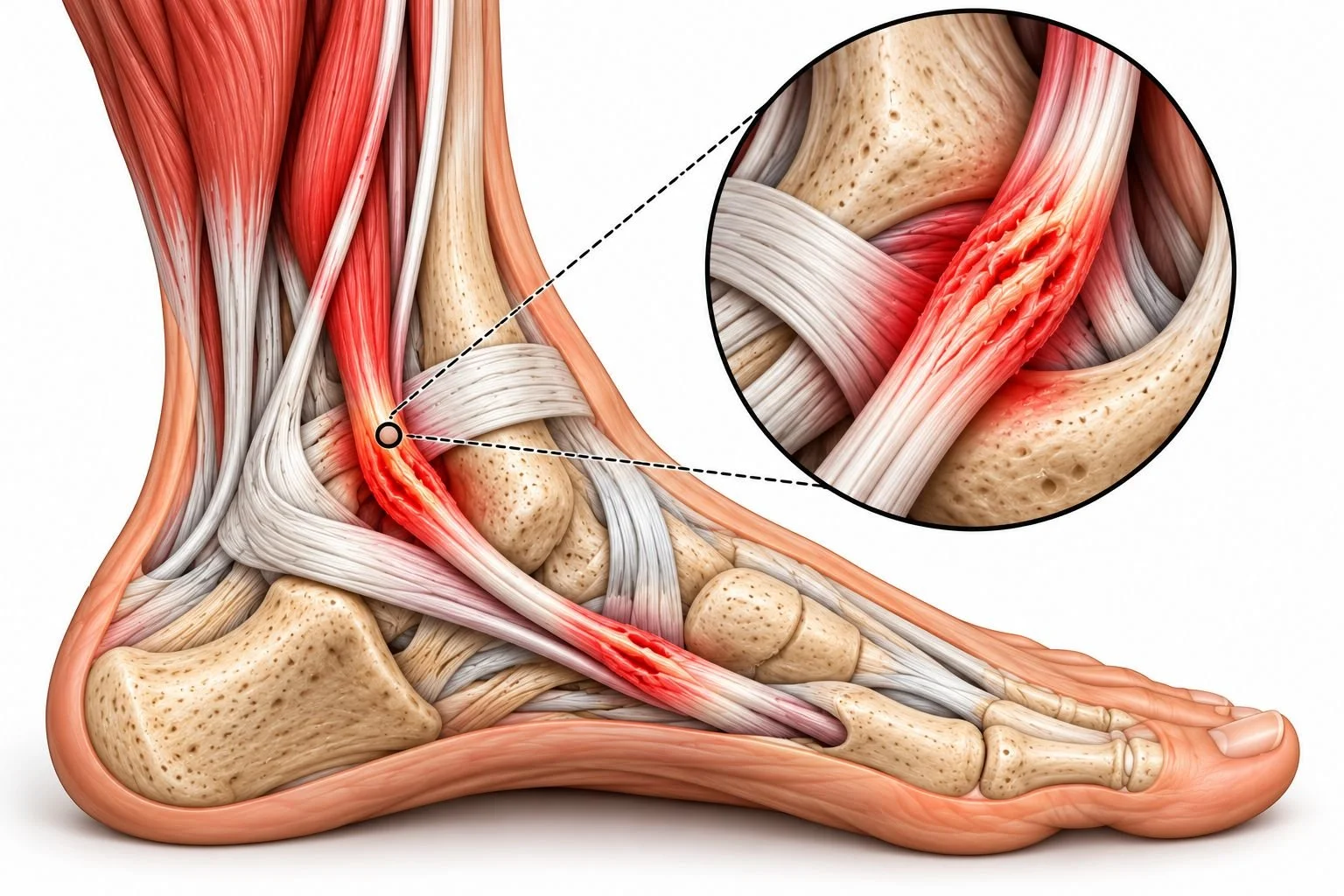
Tibialis posterior tendinopathy is a condition affecting the tibialis posterior tendon, an important tendon that runs along the inside of the lower leg and ankle and plays a key role in supporting the foot.
It can cause pain around the inside of the ankle or arch of the foot, particularly during walking, running, climbing stairs or other weight-bearing activities.
Physiotherapy can play an important role in managing tibialis posterior tendinopathy. Treatment usually focuses on reducing excessive tendon loading initially, improving the strength and capacity of the calf and foot muscles, and gradually returning to normal activities.
In some cases, tibialis posterior tendon problems can progress and contribute to changes in foot shape and function. Early assessment and appropriate rehabilitation can therefore be valuable.
What is the Tibialis Posterior Tendon?
The tibialis posterior muscle is located deep within the calf.
Its tendon travels down the inside of the lower leg, passes behind the medial malleolus (the bony prominence on the inside of the ankle) and attaches to several bones within the foot.
The tendon has several important functions, including:
Supporting the arch of the foot
Helping control the position of the foot
Assisting with foot inversion
Contributing to plantarflexion
Helping stabilise the foot during walking and running
Assisting with force production during push-off
Because the tendon is involved in supporting the foot during weight-bearing activities, it can be exposed to considerable loads.
What is Tibialis Posterior Tendinopathy?
Tibialis posterior tendinopathy occurs when the tendon becomes painful and unable to tolerate its normal level of loading.
It is often associated with an imbalance between the amount of load placed on the tendon and its current capacity to tolerate that load.
Rather than thinking of tendinopathy simply as an injury caused by inflammation, it is more useful to consider it as a condition involving changes within the tendon and its ability to tolerate load.
The condition can develop gradually or sometimes become symptomatic following a sudden increase in activity.
What Does Tibialis Posterior Tendinopathy Feel Like?
The most common symptom is pain along the inside of the ankle or foot.
You may experience:
Pain behind or below the inside ankle bone
Pain along the inside of the foot
Pain around the arch
Tenderness over the tibialis posterior tendon
Pain during walking
Pain when climbing stairs
Pain during running
Discomfort during prolonged standing
Weakness when pushing off
Fatigue in the foot or ankle
Swelling around the tendon
Symptoms are usually worse when the tendon is placed under greater load.
For example, running, jumping, hills and prolonged periods of walking can increase symptoms.
What Causes Tibialis Posterior Tendinopathy?
There is rarely one single cause.
The tendon can become overloaded when the demands placed on it increase faster than its ability to adapt.
Common contributing factors include:
Sudden increases in activity
Increasing running distance, walking volume, hill running or sporting activity too quickly can increase the load placed on the tendon.
Repetitive loading
Activities involving frequent walking, running or jumping can repeatedly load the tibialis posterior tendon.
Reduced calf strength
The calf and foot muscles work together to control movement and produce force during walking and running.
Reduced strength or endurance can alter how load is distributed through the lower limb.
Changes in foot mechanics
The tibialis posterior tendon helps support the arch of the foot.
Changes in foot posture or mechanics can alter the demands placed on the tendon.
Age-related changes
Tendon structure and capacity can change with age, meaning that some people may become less tolerant of sudden increases in activity.
Previous injury
Previous ankle or foot injuries can sometimes alter movement and loading patterns.
Is Tibialis Posterior Tendinopathy the Same as Posterior Tibial Tendon Dysfunction?
The terms are sometimes used interchangeably, but they do not necessarily describe exactly the same clinical presentation.
Tibialis posterior tendinopathy generally refers to a painful condition affecting the tendon.
Posterior tibial tendon dysfunction has historically been used to describe a broader problem involving progressive loss of tendon function and changes in foot alignment.
More recent terminology increasingly uses progressive collapsing foot deformity (PCFD) to describe presentations involving changes in foot structure and function.
This distinction is important because not everyone with tibialis posterior tendon pain has a progressive foot deformity.
Why is the Tibialis Posterior Tendon Important?
One of the tendon’s key roles is helping to support the medial arch of the foot.
When the tendon is painful or has reduced capacity, the foot may have greater difficulty controlling movement during weight-bearing.
In more advanced cases, this can contribute to:
Flattening of the arch
Increased outward positioning of the heel
Changes in foot alignment
Difficulty performing a single-leg heel raise
Reduced ability to push off during walking
These changes do not occur in everyone with tibialis posterior tendinopathy, particularly when the condition is identified and managed earlier.
How is Tibialis Posterior Tendinopathy Diagnosed?
Diagnosis is primarily based on your symptoms and a clinical assessment.
Your physiotherapist may assess:
Pain location
Tenderness along the tendon
Foot posture
Walking pattern
Single-leg balance
Calf strength
Single-leg heel raise ability
Foot and ankle movement
Strength of the tibialis posterior and other supporting muscles
Functional activities such as walking, running or hopping
Your physiotherapist may also assess the rest of the lower limb, including the knee and hip.
This helps identify factors that may be contributing to increased load through the tendon.
Do You Need a Scan?
Not everyone with tibialis posterior tendinopathy requires imaging.
A clinical assessment can often provide enough information to begin treatment.
However, ultrasound or MRI may sometimes be appropriate when:
The diagnosis is uncertain
Symptoms are persistent despite appropriate rehabilitation
There is significant swelling
A tendon tear is suspected
There are substantial changes in foot shape
Surgery is being considered
Imaging should generally be interpreted alongside the clinical presentation rather than being used in isolation.
How Can Physiotherapy Help Tibialis Posterior Tendinopathy?
Physiotherapy management is centred around progressively restoring the tendon’s capacity to tolerate load.
Treatment is usually individualised according to the severity of symptoms, your activity level and your functional goals.
1. Load Management
One of the first steps is often identifying activities that are currently placing too much load on the tendon.
This may include temporarily modifying:
Running
Jumping
Long walks
Hill walking
Stair climbing
Prolonged standing
Sporting activities
This does not necessarily mean complete rest.
In most cases, the aim is to find an appropriate level of activity that allows you to remain active without repeatedly aggravating the tendon.
For example, a runner may temporarily reduce running volume while maintaining fitness through cycling, swimming or other suitable activities.
2. Calf Strengthening
The calf muscles and tibialis posterior work together to produce force and control the ankle during weight-bearing.
Strengthening the calf is therefore often an important component of rehabilitation.
Exercises may progress from:
Seated calf raises
Double-leg calf raises
Single-leg calf raises
Loaded calf raises
Single-leg functional exercises
The specific exercise selection and progression should reflect your symptoms and current capacity.
3. Tibialis Posterior Strengthening
Specific strengthening can also target the tibialis posterior and the muscles supporting the foot.
Exercises may include resisted foot inversion and progressively loaded heel-raise exercises.
However, rehabilitation should not focus exclusively on one muscle.
The foot and ankle function as a system, so strengthening the calf, foot and wider lower limb can be important.
4. Progressive Tendon Loading
A key principle of tendon rehabilitation is progressive loading.
The tendon needs an appropriate stimulus to increase its capacity.
This can involve gradually increasing:
Resistance
Repetitions
Load
Exercise complexity
Speed
Impact
Running volume
The progression should be based on your response to exercise rather than following an arbitrary timeline.
A small amount of discomfort during rehabilitation can sometimes be acceptable, but a significant or sustained increase in symptoms may indicate that the current loading level is too high.
5. Balance and Proprioception
Balance exercises can help improve control of the foot and ankle.
Examples may include:
Single-leg standing
Single-leg reaching exercises
Balance on unstable surfaces
Functional single-leg exercises
Progressively more challenging sport-specific movements
These exercises can be particularly useful when returning to running or sport.
6. Foot and Ankle Mobility
Your physiotherapist may assess the movement available at the ankle and foot.
Restrictions in ankle dorsiflexion, for example, may influence how the foot and lower limb move during activities such as squatting, walking and running.
Where appropriate, mobility exercises or manual therapy may be incorporated into the rehabilitation programme.
7. Footwear
Footwear can influence the amount of support and load experienced by the foot.
Depending on your presentation, your physiotherapist may discuss:
Appropriate footwear
Shoe condition
Activity-specific footwear
Cushioning and support
Changes in footwear during rehabilitation
There is no single shoe that is appropriate for everyone.
The goal is to find footwear that is comfortable and suitable for your individual requirements.
8. Orthotics
Some people with tibialis posterior tendon problems may benefit from temporary or longer-term foot orthoses.
Orthoses can alter how load is distributed through the foot and may help reduce symptoms in selected patients.
However, they should generally be viewed as an adjunct to rehabilitation rather than a replacement for strengthening.
Your physiotherapist can assess whether an orthotic intervention is appropriate for your presentation.
Can Shockwave Therapy Help Tibialis Posterior Tendinopathy?
Shockwave therapy is used clinically for a range of persistent tendon conditions. It uses acoustic energy to stimulate a biological response within the treated tissues. There is evidence supporting shockwave therapy for some tendinopathies, particularly conditions such as plantar heel pain and certain chronic tendon disorders. However, the evidence specifically for tibialis posterior tendinopathy is more limited.
For this reason, shockwave should not replace the core components of rehabilitation. Where appropriate, it may be considered as an adjunct to a progressive loading programme, particularly when symptoms have become persistent.
A clinician should assess the individual presentation before deciding whether shockwave is appropriate.
Can You Run With Tibialis Posterior Tendinopathy?
Possibly, depending on the severity of your symptoms.
Complete rest is not always necessary.
If running does not significantly aggravate your symptoms, you may be able to continue at a modified level.
This could involve reducing:
Running distance
Running frequency
Pace
Hill running
Speed work
Jumping or other high-impact training
Your physiotherapist can help establish an appropriate level of running and develop a progressive return-to-running programme.
Returning to Sport
Returning to sport should be progressive.
Before returning to higher-impact activity, you should ideally have developed sufficient:
Calf strength
Foot strength
Single-leg control
Balance
Hopping capacity
Running tolerance
Sport-specific drills can then be introduced progressively.
For a footballer, for example, this may eventually include acceleration, deceleration, cutting and changes of direction.
For a runner, rehabilitation may progress from walking to jogging before gradually increasing running duration, speed and hills.
How Long Does Tibialis Posterior Tendinopathy Take to Improve?
There is no single recovery timeline.
Factors that can influence recovery include:
How long symptoms have been present
Severity of the tendon problem
Current tendon capacity
Activity demands
Foot structure
Strength levels
Previous injuries
Consistency with rehabilitation
Tendons generally respond to progressive rehabilitation over time, so improvement may take several weeks or months rather than occurring immediately.
The goal is not simply to reduce pain but to restore the tendon’s ability to tolerate the activities that matter to you.
When Should You See a Physiotherapist?
Consider an MSK physiotherapy assessment if you have:
Persistent pain around the inside of your ankle
Pain around the arch of your foot
Symptoms that are limiting walking or running
Increasing difficulty with calf raises
Recurrent swelling around the inside of the ankle
Reduced sporting performance
Symptoms that are not improving with self-management
Early assessment can help identify the likely cause of your symptoms and establish an appropriate rehabilitation programme.
When Should You See a Doctor or Specialist?
Some presentations require further investigation or specialist assessment.
This is particularly important if you develop:
Significant or rapidly worsening foot deformity
Inability to perform a single-leg heel raise
Significant weakness
Persistent swelling
Severe pain following an injury
Inability to weight-bear
Symptoms that fail to improve despite appropriate rehabilitation
Significant changes in foot shape or progressive loss of tendon function may require assessment by an appropriate foot and ankle specialist.
Frequently Asked Questions
Is tibialis posterior tendinopathy serious?
Many cases respond well to appropriate conservative management. However, persistent tendon dysfunction can contribute to changes in foot alignment, so ongoing symptoms should not simply be ignored.
Can tibialis posterior tendinopathy heal?
Yes. Tendons can adapt to progressive loading and rehabilitation. Recovery depends on the severity of the condition, the individual's tendon capacity and the demands placed upon it.
Should I stop running?
Not necessarily. Depending on the severity of symptoms, running may be modified rather than stopped completely. Your physiotherapist can help determine an appropriate level of running.
Are orthotics necessary?
Not everyone needs orthotics. They may be useful for some people, particularly where foot mechanics or arch support are contributing to symptoms, but they should generally complement rather than replace rehabilitation.
Is shockwave therapy effective for tibialis posterior tendinopathy?
Evidence specifically investigating shockwave therapy for tibialis posterior tendinopathy is limited compared with some other tendon conditions. It may be considered as an adjunct in selected persistent cases, but progressive exercise remains a key component of rehabilitation.
How long does recovery take?
Recovery varies between individuals. Mild cases may improve relatively quickly, while more established tendon problems can require several months of progressive rehabilitation.
Summary
Tibialis posterior tendinopathy is a condition affecting an important tendon that helps support the foot and control movement during walking, running and other weight-bearing activities.
Pain is commonly experienced around the inside of the ankle or arch of the foot and may be aggravated by running, walking, stairs or prolonged standing.
Physiotherapy management focuses on restoring the tendon’s capacity to tolerate load.
Treatment may include:
Activity and load management
Calf strengthening
Tibialis posterior strengthening
Progressive tendon loading
Foot and ankle exercises
Balance and proprioception training
Footwear advice
Orthotics where appropriate
Running and sports rehabilitation
Shockwave therapy as an adjunct in selected cases
The earlier a persistent tendon problem is assessed, the easier it can be to identify contributing factors and develop an appropriate rehabilitation strategy.
If you are experiencing pain around the inside of your ankle or foot, an MSK physiotherapy assessment can help determine whether tibialis posterior tendinopathy is contributing to your symptoms and guide you through an appropriate rehabilitation programme.
