
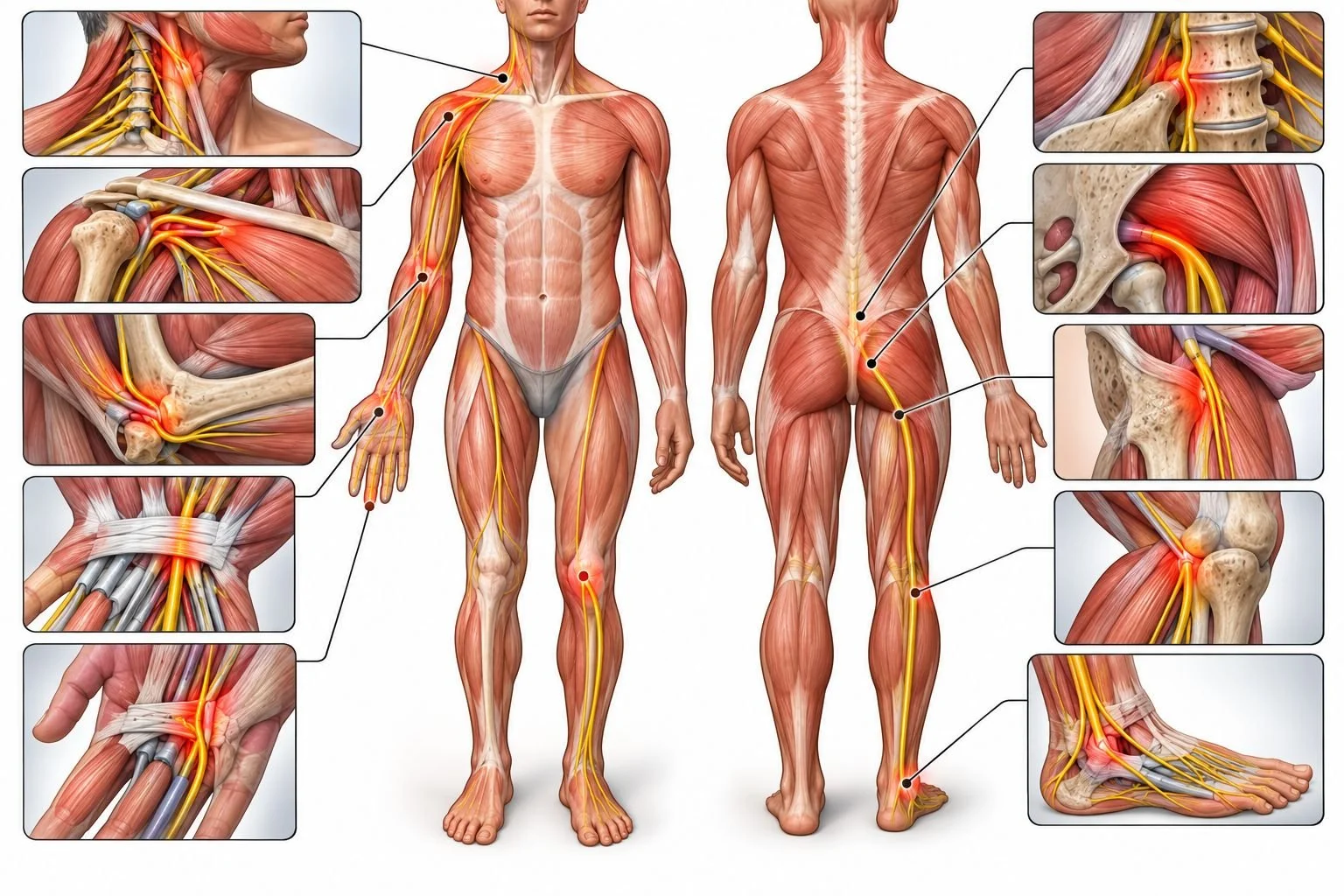
Peripheral neuropathy can be a frustrating and persistent condition. Symptoms such as burning, pins and needles, numbness, altered sensation and nerve pain can significantly affect sleep, mobility, exercise and everyday life.
While treatment traditionally focuses on identifying and managing the underlying cause, controlling symptoms and maintaining function, there is growing interest in extracorporeal shockwave therapy (ESWT) as a potential treatment for peripheral nerve disorders.
In particular, focused shockwave therapy is being investigated for its potential effects on nerve function, pain and tissue healing.
But what exactly is peripheral neuropathy, how does focused shockwave therapy work, and what does the current evidence tell us?
What is Peripheral Neuropathy?
Peripheral neuropathy refers to damage or dysfunction affecting the nerves outside the brain and spinal cord.
These nerves carry information between the central nervous system and the rest of the body. When they become damaged or their function is disrupted, symptoms can develop in the hands, feet, legs or other areas.
Peripheral neuropathy can affect:
Sensory nerves
Motor nerves
Autonomic nerves
Or a combination of these
The symptoms depend on which nerves are affected and the underlying cause.
What Does Peripheral Neuropathy Feel Like?
Symptoms can vary considerably between individuals.
Common symptoms include:
Burning pain
Pins and needles
Tingling
Numbness
Electric or shooting sensations
Increased sensitivity to touch
Reduced sensation
Altered temperature sensation
Muscle weakness
Reduced balance or coordination
Symptoms often affect the feet and lower legs first, particularly in people with length-dependent peripheral neuropathy.
Some people describe the sensation as feeling like they are walking on a different surface or having persistent burning underneath their feet.
Symptoms can be particularly troublesome at night and may interfere with sleep.
What Causes Peripheral Neuropathy?
There are many possible causes of peripheral neuropathy.
One of the most common is diabetes, where prolonged changes in blood glucose can contribute to nerve damage.
Other possible causes include:
Nerve injuries
Entrapment or compression of individual nerves
Vitamin deficiencies
Certain medications
Chemotherapy
Alcohol-related nerve damage
Autoimmune conditions
Infections
Kidney disease
Certain inherited neurological conditions
Sometimes, despite appropriate investigation, the exact cause may remain unclear.
Identifying the underlying cause is important because treatment should not simply focus on managing the symptoms.
Diabetic Peripheral Neuropathy
Diabetes is an important cause of peripheral neuropathy.
Peripheral neuropathy associated with diabetes can reduce sensation in the feet, meaning that injuries, pressure or skin problems may not always be noticed.
NICE recommends regular foot assessment in people with diabetes and specifically includes assessment for neuropathy using sensory testing such as a 10 g monofilament.
This is particularly important because reduced sensation can increase the risk of foot problems, including ulceration.
If you have diabetes and reduced sensation in your feet, appropriate medical and diabetic foot care should remain a priority.
How is Peripheral Neuropathy Diagnosed?
A thorough assessment is important before considering any treatment.
Your healthcare professional may assess:
Your symptoms
Sensation
Reflexes
Muscle strength
Balance
Walking pattern
Skin and foot health
Circulation
Relevant medical history
Medication
Potential causes of the neuropathy
Depending on your presentation, further investigations may include blood tests, nerve conduction studies or electromyography.
This is important because not every symptom described as "nerve pain" is caused by peripheral neuropathy.
Symptoms can also arise from nerve compression, spinal conditions or other neurological disorders.
What is Focused Shockwave Therapy?
Focused shockwave therapy is a form of extracorporeal shockwave therapy (ESWT).
It uses acoustic waves delivered through the skin to a specific target area.
Unlike radial pressure wave therapy, where energy is delivered more superficially and disperses from the applicator, focused shockwave can deliver energy towards a defined target and at a selected depth.
This makes focused shockwave particularly interesting when the clinician needs to target a specific anatomical region.
Shockwave therapy is already used in MSK practice for a range of conditions, including certain tendinopathies and other persistent musculoskeletal problems.
Research is now investigating whether its biological effects may also have applications in peripheral nerve disorders.
How Could Focused Shockwave Affect Peripheral Nerves?
The exact mechanisms by which shockwave may influence peripheral nerves are still being investigated.
Shockwaves produce mechanical stimuli within tissue. These mechanical forces may influence cellular signalling and tissue responses through a process known as mechanotransduction.
Potential effects being investigated include:
Changes in local blood flow
Cellular signalling
Modulation of pain pathways
Changes in nerve function
Promotion of tissue regeneration
Effects on nerve conduction
Changes in the local inflammatory environment
However, it is important to distinguish between proposed biological mechanisms and proven clinical outcomes.
Research has demonstrated changes in some nerve conduction measurements following ESWT, but this does not necessarily mean that shockwave will restore damaged nerves or eliminate neuropathy in every patient.
What Does the Evidence Say?
Research into shockwave therapy for peripheral nerve disorders is developing.
A 2024 systematic review and meta-analysis examined 24 trials investigating ESWT and peripheral nerve function, with 22 studies included in the meta-analysis.
The researchers reported improvements in several sensory nerve conduction measures, including sensory nerve conduction velocity and sensory nerve action potential outcomes. They also found that combining ESWT with physiotherapy produced improvements in some nerve conduction outcomes compared with physiotherapy alone.
These findings are encouraging because they suggest that focused ESWT may have measurable effects on peripheral nerve function.
However, the studies included different neurological conditions and treatment approaches. The authors also highlighted the need for further research, particularly regarding motor nerve function and the optimal treatment protocols.
Therefore, the evidence should currently be viewed as promising but still developing.
Is Focused Shockwave Proven to Repair Damaged Nerves?
Not yet.
This is an important distinction.
There is emerging evidence that focused ESWT can influence nerve conduction and neurological outcomes, but it would be inappropriate to describe focused shockwave as a guaranteed method of "repairing" damaged nerves.
Peripheral neuropathy has many different causes and degrees of severity.
The response to treatment is therefore likely to depend on factors such as:
The underlying cause
Duration of symptoms
Severity of nerve damage
Type of nerve affected
Whether the underlying cause is being controlled
Presence of other medical conditions
Focused shockwave should therefore be considered a potential adjunctive treatment, rather than a replacement for appropriate medical management.
How Might Focused Shockwave Therapy Be Used?
Where clinically appropriate, focused shockwave therapy may be incorporated into a broader rehabilitation programme.
Treatment should begin with a detailed assessment to determine whether the symptoms are consistent with a peripheral nerve disorder and whether shockwave is appropriate.
A treatment programme may combine:
Clinical assessment → identification of contributing factors → medical management where required → focused shockwave → exercise and rehabilitation → monitoring of symptoms and function
The precise treatment area and parameters should be individualised.
For example, treatment may be directed towards an affected peripheral nerve or a relevant anatomical region depending on the clinical presentation.
The objective is not simply to treat where the pain is felt.
Instead, treatment should be based on an understanding of the underlying neurological and anatomical problem.
Focused Shockwave and Diabetic Peripheral Neuropathy
Diabetic peripheral neuropathy is one area where research into ESWT has attracted particular interest.
Research has investigated whether shockwave can influence nerve function and symptoms in people with diabetic neuropathy.
However, diabetic neuropathy requires a broader approach than simply treating nerve symptoms.
Blood glucose management, regular foot assessment, skin care, appropriate footwear, exercise and management of cardiovascular risk factors can all be important.
NICE identifies neuropathy as a risk factor for diabetic foot problems and recommends appropriate foot assessment and risk stratification.
If you have diabetes and reduced sensation in your feet, shockwave therapy should therefore only be considered as part of appropriate overall care.
Focused Shockwave and Neuropathic Foot Problems
There is another area where focused shockwave has been investigated: diabetic foot ulcers associated with neuropathy.
This is different from treating peripheral neuropathy itself.
Clinical trials have investigated focused ESWT as an adjunct to standard care for selected diabetic foot ulcers. One pair of multicentre randomised controlled trials involving 336 patients found higher rates of complete ulcer healing at 20 and 24 weeks in the focused ESWT group compared with sham treatment, when both groups continued to receive standard care.
Systematic reviews have also reported potential benefits of ESWT for diabetic foot-ulcer healing, although the certainty of evidence has been limited by methodological concerns and variation between studies.
This research is interesting, but it should not be interpreted as evidence that focused shockwave cures peripheral neuropathy.
A diabetic foot ulcer and peripheral neuropathy are different clinical problems.
Can Physiotherapy Help Peripheral Neuropathy?
Physiotherapy can play an important role in managing the functional consequences of peripheral neuropathy.
Depending on the individual, treatment may include:
Exercise therapy
Exercise can be used to maintain strength, mobility and physical function.
Depending on your presentation, this may include:
Strength training
Balance exercises
Walking programmes
Aerobic exercise
Mobility exercises
Functional rehabilitation
Balance rehabilitation
Reduced sensation in the feet can affect proprioception and balance.
Balance exercises can help develop strategies for maintaining stability and confidence during everyday activities.
Gait rehabilitation
If neuropathy has affected walking, your physiotherapist can assess your gait and identify strategies to improve mobility and safety.
Education
Understanding the condition is an important part of rehabilitation.
This may include advice about:
Foot care
Activity levels
Exercise
Footwear
Falls prevention
Monitoring symptoms
Pain management
Physiotherapy can also form part of a multidisciplinary approach to managing persistent neuropathic pain.
Medication may be appropriate for some people and should be discussed with an appropriate medical professional.
What Happens During a Focused Shockwave Treatment?
If focused shockwave is considered appropriate, your physiotherapist will first identify the treatment area and explain the procedure.
A handheld applicator is positioned against the skin and delivers acoustic pulses into the targeted area.
You may feel a tapping, pressure or pulsing sensation during treatment.
The intensity can generally be adjusted according to the treatment area and individual tolerance.
Treatment duration and the number of sessions depend on the condition being treated, the treatment protocol and the individual clinical presentation.
Because there is currently no universally established protocol for peripheral neuropathy, treatment parameters should be selected by a suitably trained clinician based on the available evidence and the individual patient.
Is Focused Shockwave Therapy Painful?
Shockwave treatment can produce sensations ranging from mild discomfort to a more noticeable tapping or pressure sensation.
The experience varies depending on:
Treatment location
Treatment intensity
Individual sensitivity
The underlying condition
The specific shockwave device being used
Your clinician should monitor your response throughout treatment.
The aim is not to use unnecessarily high levels of energy.
Are There Risks or Contraindications?
As with any treatment, shockwave therapy is not appropriate for everyone.
A full medical and clinical assessment should take place before treatment.
Particular caution is required in people with certain medical conditions, including some bleeding disorders, infections or significant vascular problems.
The treatment area should also be assessed carefully where there is reduced sensation.
This is particularly important in people with diabetic peripheral neuropathy.
If sensation is reduced, you may not accurately feel excessive treatment intensity or irritation to the skin and tissues.
People with diabetes and neuropathy may also have an increased risk of foot complications. NICE recommends assessing the feet for neuropathy, circulation problems, ulceration, infection, deformity and other risk factors.
For this reason, shockwave treatment should only be provided following an appropriate clinical assessment.
Is Focused Shockwave Therapy Right for Everyone With Peripheral Neuropathy?
No. Peripheral neuropathy is a broad term covering many different conditions and causes.
Focused shockwave may be worth discussing in selected cases, particularly where there is an appropriate clinical rationale and conventional management has not provided sufficient improvement.
However, it should not replace:
Diagnosis of the underlying cause
Appropriate medical management
Diabetes management where relevant
Foot protection
Management of vascular risk factors
Medication where clinically indicated
Neurological assessment where required
Exercise and rehabilitation
The most appropriate treatment depends on the individual.
When Should You See a Doctor?
Peripheral neuropathy can sometimes indicate an underlying medical condition that requires investigation.
Medical assessment is particularly important if you develop:
New or rapidly progressing numbness
Significant or progressive weakness
Loss of balance
Unexplained symptoms affecting multiple limbs
New bladder or bowel symptoms alongside neurological changes
A wound or ulcer that is not healing
Changes in foot colour or temperature
Significant swelling or infection
Severe unexplained nerve pain
For people with diabetes, foot ulcers, infection, gangrene, significant ischaemia or suspected Charcot arthropathy require prompt specialist assessment. NICE recommends urgent referral pathways for active or limb-threatening diabetic foot problems.
Frequently Asked Questions
Can focused shockwave therapy treat peripheral neuropathy?
There is emerging evidence that ESWT may influence peripheral nerve function and some nerve conduction measures. However, evidence specifically establishing focused shockwave as a treatment that reverses peripheral neuropathy remains limited.
Can shockwave repair damaged nerves?
Research suggests that shockwave may influence nerve conduction and biological processes associated with nerve function. However, it is too early to claim that shockwave reliably repairs damaged peripheral nerves.
Is focused shockwave better than radial shockwave for neuropathy?
There is currently insufficient evidence to make a general claim that focused shockwave is superior to radial shockwave for peripheral neuropathy. Research has used both types of ESWT, with considerable variation between studies.
How many shockwave treatments will I need?
There is no universally established treatment protocol for peripheral neuropathy. The number of treatments should depend on the individual condition, treatment response and the clinical protocol being used.
Can shockwave cure diabetic neuropathy?
There is currently insufficient evidence to describe shockwave as a cure for diabetic peripheral neuropathy. It may have potential as an adjunctive treatment, but diabetes management and appropriate foot care remain essential.
Can I have shockwave if I have numb feet?
Reduced sensation requires additional caution because you may not be able to accurately report treatment discomfort. Your clinician should assess your sensation, circulation, skin integrity and overall risk before deciding whether treatment is appropriate.
The Bottom Line
Peripheral neuropathy can cause persistent pain, burning, pins and needles, numbness and weakness, with symptoms often affecting the feet and hands.
Focused shockwave therapy is an emerging treatment option being investigated for peripheral nerve disorders. Current research suggests that ESWT may influence peripheral nerve function and some measures of nerve conduction, but the evidence is still developing and further high-quality research is needed.
For this reason, focused shockwave should be viewed as a potential adjunct to a wider rehabilitation and medical management programme, rather than a standalone cure for peripheral neuropathy.
If you are experiencing persistent burning, tingling, pins and needles, numbness or altered sensation in your hands or feet, an appropriate clinical assessment can help determine the next steps in your management.
