
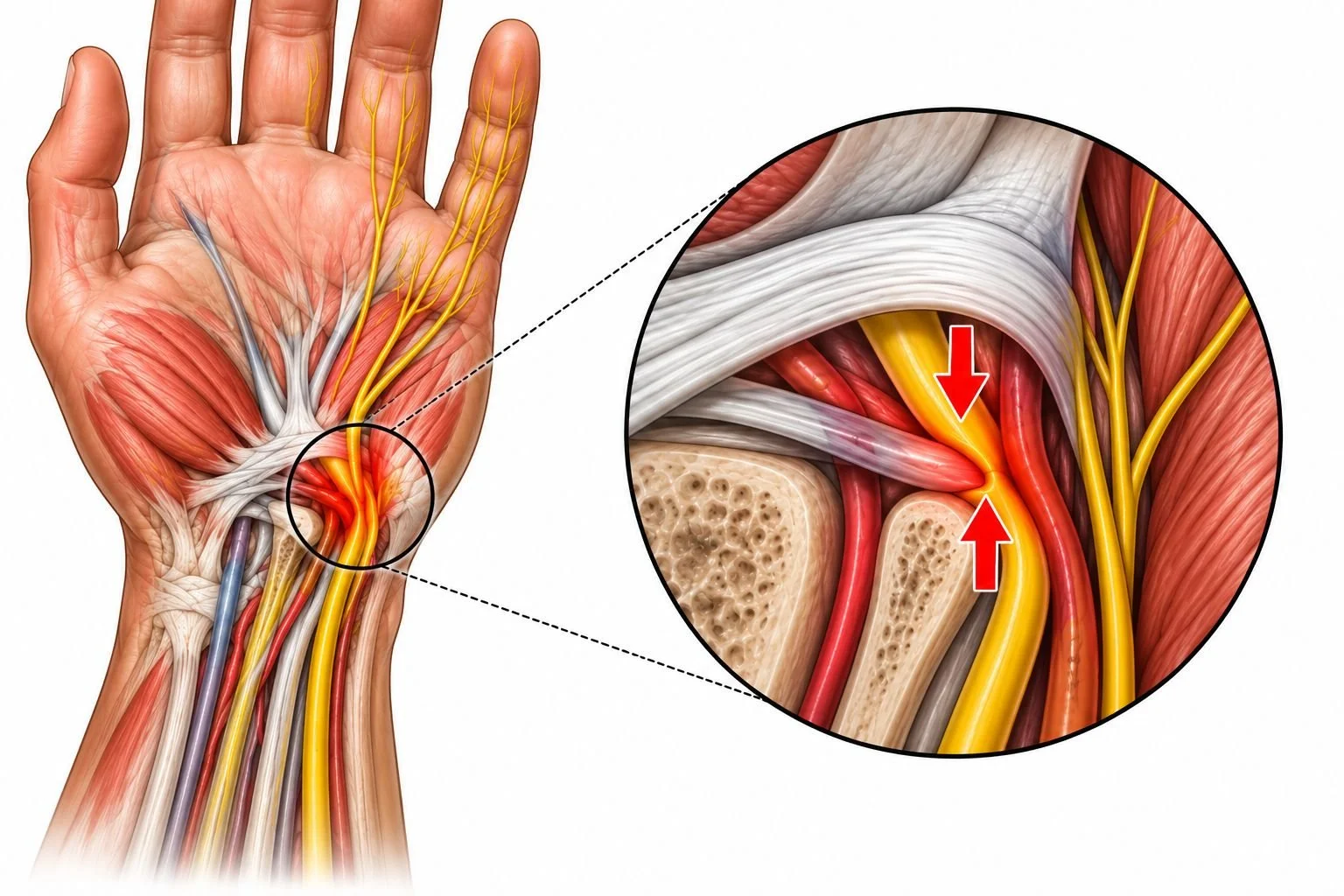
Guyon’s Canal Syndrome is a condition involving compression or irritation of the ulnar nerve at the wrist. The ulnar nerve travels from the neck, through the arm and into the hand, providing sensation to part of the hand and helping control several of the muscles responsible for finger and thumb movement.
When the ulnar nerve becomes compressed as it passes through Guyon’s canal, it can cause symptoms such as numbness, tingling, pain or weakness in the hand.
MSK physiotherapy can form an important part of conservative management. Treatment aims to identify what is irritating the nerve, reduce aggravating factors, restore normal movement and gradually improve hand and wrist function.
What is Guyon’s Canal?
Guyon’s canal, also known as Guyon’s tunnel, is a small anatomical passageway located on the little-finger side of the wrist.
The ulnar nerve passes through this canal before entering the hand.
The ulnar nerve is responsible for:
Sensation to the little finger
Sensation to the little-finger side of the ring finger
Movement of several small muscles within the hand
Contributing to grip and fine finger control
Because the canal is relatively narrow, anything that increases pressure within this area can potentially irritate or compress the ulnar nerve.
What is Guyon’s Canal Syndrome?
Guyon’s Canal Syndrome occurs when the ulnar nerve is compressed or irritated as it passes through Guyon’s canal.
It is sometimes referred to as ulnar tunnel syndrome.
The symptoms can vary depending on exactly where the nerve is being compressed.
Some people primarily experience sensory symptoms, while others develop weakness or changes in hand function.
Common symptoms include:
Tingling in the little finger
Numbness in the little finger
Numbness or tingling on the little-finger side of the ring finger
Pain around the wrist or hand
Weak grip
Difficulty with fine finger movements
Difficulty spreading the fingers
Difficulty bringing the fingers together
Reduced coordination
Muscle wasting in more advanced cases
Symptoms may develop gradually or appear more suddenly following an injury or prolonged pressure on the wrist.
What Causes Guyon’s Canal Syndrome?
There are several potential causes of ulnar nerve compression at Guyon’s canal. Common contributing factors include:
Prolonged pressure on the wrist
Repetitive hand and wrist movements
Ganglion cysts
Wrist trauma
Fractures
Arthritis or changes around the wrist
Repetitive loading
Guyon’s Canal Syndrome vs Carpal Tunnel Syndrome
Guyon’s Canal Syndrome and Carpal Tunnel Syndrome are sometimes confused because both involve nerve compression around the wrist.
However, they affect different nerves.
Guyon’s Canal Syndrome:
Compression of the ulnar nerve.
Carpal Tunnel Syndrome:
Compression of the median nerve.
The distribution of symptoms is therefore different.
Guyon’s Canal Syndrome typically affects the little finger and the little-finger side of the ring finger, whereas Carpal Tunnel Syndrome more commonly affects the thumb, index and middle fingers.
There can also be differences in which muscles are affected.
A thorough clinical assessment is therefore important when someone presents with hand numbness or tingling.
How is Guyon’s Canal Syndrome Diagnosed?
Diagnosis usually starts with a detailed history and physical examination.
Your physiotherapist may assess:
The location and nature of your symptoms
Wrist and hand movement
Grip strength
Finger strength and coordination
Sensation in the hand
The ulnar nerve
The wrist and surrounding structures
The neck and upper limb where appropriate
Activities that reproduce your symptoms
Your physiotherapist may also assess whether the symptoms could be coming from somewhere else.
For example, irritation of the ulnar nerve can occur at other locations, including around the elbow or neck.
This is important because treating the wrist alone may not address the underlying problem if the nerve is being irritated elsewhere.
Do You Need a Scan or Nerve Test?
Not everyone with suspected Guyon’s Canal Syndrome requires imaging or nerve conduction testing.
However, further investigations may be appropriate when:
The diagnosis is unclear
Symptoms are persistent
There is significant weakness
There is muscle wasting
A ganglion cyst or other structural problem is suspected
Symptoms are progressing
Surgery is being considered
Nerve conduction studies and electromyography (EMG) can help assess how well the ulnar nerve is functioning and can sometimes help identify the location and severity of nerve involvement.
Ultrasound or MRI may also be considered where a structural cause, such as a ganglion cyst, needs to be investigated.
The appropriate investigation depends on the individual clinical presentation.
How Can MSK Physiotherapy Help Guyon’s Canal Syndrome?
Physiotherapy management is generally focused on reducing irritation of the ulnar nerve while addressing the factors contributing to symptoms.
Treatment may include several different components:
1. Activity Modification - modify the load sufficiently to allow the nerve to settle while maintaining as much normal activity as possible.
2. Ergonomic Advice - Small changes can sometimes significantly reduce repeated irritation of the wrist and hand.
3. Reducing Pressure Through the Wrist - applicable to leisure, occupational, daily and gym-based activities.
4. Wrist Splinting - aims to reduce excessive or sustained wrist positioning while the symptoms settle, rather than permanently restricting wrist movement.
5. Nerve Mobilisation
6. Hand and Wrist Strengthening
7. Addressing the Whole Upper Limb
8. Manual Therapy
Can Shockwave Therapy Be Used for Guyon’s Canal Syndrome?
Yes, There is emerging research investigating extracorporeal shockwave therapy for peripheral nerve conditions and neuropathic pain. However the exact mechanisms by which shockwave may influence the peripheral nerves is still being investigated.
Focused Shockwave produceses mechanical stimuli within tissue. These mechanical forces may influence cellular signalling and tissue responses through a process known as mechanotransduction.
Potential effects being investigated include:
Changes in local blood flow
Cellular signalling
Modulation of pain pathways
Changes in nerve function
Promotion of tissue regeneration
Effects on nerve conduction
Changes in the local inflammatory environment
However, it is important to distinguish between proposed biological mechanisms and proven clinical outcomes.
Research has demonstrated changes in some nerve conduction measurements following focused ESWT, but this does not necessarily mean that shockwave will restore damaged nerves or eliminate neuropathy in every patient.
When Might You Need Specialist Assessment?
Although physiotherapy can be appropriate for mild or early symptoms, persistent or progressive neurological symptoms require appropriate medical assessment.
You should seek medical assessment if you experience:
Increasing numbness
Persistent loss of sensation
Progressive weakness
Significant loss of grip strength
Difficulty spreading or closing your fingers
Muscle wasting in the hand
Increasing difficulty with everyday tasks
Symptoms following significant trauma
A lump or swelling around the wrist
Muscle wasting or progressive weakness can indicate more significant nerve dysfunction and should not simply be treated as a routine wrist problem.
Can Guyon’s Canal Syndrome Require Surgery?
Some cases of Guyon’s Canal Syndrome may require surgical treatment, particularly when there is significant or persistent nerve compression.
Surgery may be considered where:
Conservative management has not resolved symptoms
There is significant nerve compression
There is progressive weakness
Muscle wasting is present
A structural cause requires removal
There is a ganglion cyst or other space-occupying lesion
Where surgery is required, physiotherapy can form part of the rehabilitation process before and after the procedure.
What Can You Do Yourself?
If your symptoms are mild and have recently developed, reducing activities that place pressure through the wrist may be a useful starting point.
Depending on your symptoms, this may involve:
Taking regular breaks from repetitive activities
Avoiding prolonged pressure through the palm
Changing wrist positions regularly
Modifying cycling or gym activities
Avoiding prolonged gripping where possible
Maintaining comfortable wrist and hand movement
Gradually returning to normal activity as symptoms improve
However, persistent numbness or weakness should be assessed rather than managed indefinitely through self-treatment.
Frequently Asked Questions
Is Guyon’s Canal Syndrome the same as Carpal Tunnel Syndrome?
No. Guyon’s Canal Syndrome involves compression of the ulnar nerve, while Carpal Tunnel Syndrome involves compression of the median nerve.
Can physiotherapy treat Guyon’s Canal Syndrome?
Physiotherapy can be useful for conservative management, particularly where symptoms are related to activity, positioning or mechanical irritation. Treatment may include activity modification, ergonomic advice, nerve mobilisation, strengthening and addressing contributing factors.
How long does Guyon’s Canal Syndrome take to improve?
Recovery varies considerably depending on the cause, severity and duration of nerve compression. Mild irritation may settle with appropriate activity modification, while more significant nerve compression can require specialist investigation and potentially surgery.
Can cycling cause Guyon’s Canal Syndrome?
Cycling can contribute to ulnar nerve irritation because prolonged pressure through the handlebars can place pressure on the area around Guyon’s canal. Adjusting riding position, reducing continuous pressure and regularly changing hand position may help reduce this load.
Do I need surgery?
Not necessarily. Some people can be successfully managed conservatively. However, persistent numbness, progressive weakness or muscle wasting requires appropriate medical assessment.
Summary
Guyon’s Canal Syndrome is a condition involving compression or irritation of the ulnar nerve at the wrist. It can cause numbness, tingling, pain and weakness affecting the little finger and the adjacent part of the hand.
MSK physiotherapy can help by identifying contributing factors and developing an individualised rehabilitation programme. This may include:
Activity modification
Ergonomic advice
Reducing pressure through the wrist
Splinting where appropriate
Ulnar nerve mobilisation
Progressive hand and wrist strengthening
Manual therapy where indicated
Addressing contributing factors throughout the upper limb
Unlike some tendon and soft-tissue conditions, there is currently limited evidence for using shockwave therapy specifically for Guyon’s Canal Syndrome. It should therefore not be presented as a routine first-line treatment.
Where symptoms are persistent, worsening or associated with significant weakness or muscle wasting, further medical or specialist assessment may be required.
If you are experiencing persistent numbness, tingling or weakness in your hand, an MSK physiotherapy assessment can help determine the likely source of your symptoms and whether physiotherapy is appropriate.
