
Focused Shockwave Therapy vs Radial Shockwave: Which Is Better for MSK Conditions?
Shockwave therapy has become an increasingly popular treatment option for a wide range of musculoskeletal (MSK) conditions, including tendinopathies, plantar heel pain, calcific tendinopathy and chronic soft-tissue problems.
However, not all shockwave therapy is the same.
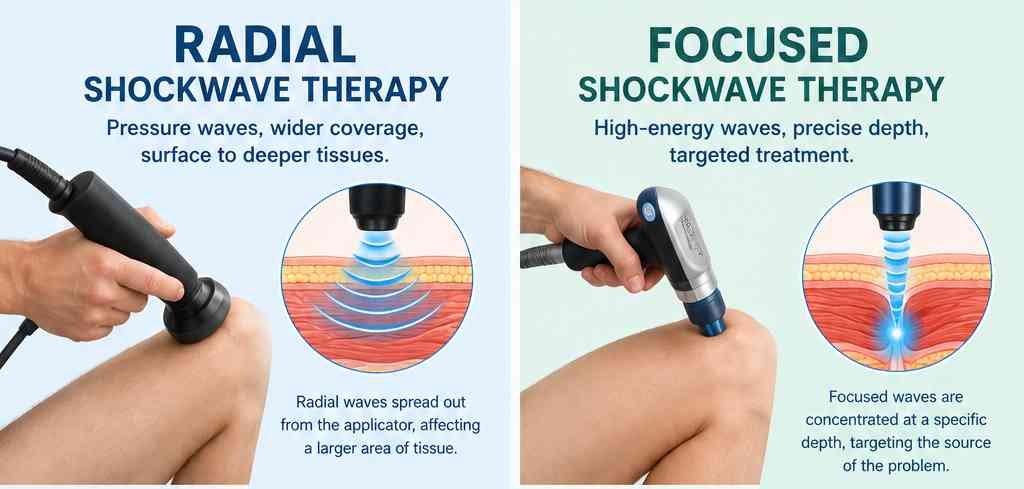
The two main technologies used in MSK physiotherapy are focused shockwave therapy (FSWT) and radial shockwave therapy (RSWT). Although they are often grouped together under the term "shockwave therapy", they produce different types of acoustic energy and interact with the body's tissues in different ways.
So, which one is better?
The answer depends on the condition being treated, the location and depth of the tissue involved, and the treatment objectives. Focused shockwave can offer important advantages where a clinician needs to target a specific structure or deeper tissue.
What is focused shockwave therapy?
Focused shockwave therapy uses acoustic shockwaves that converge towards a defined focal point within the body.
Unlike radial pressure waves, which spread outwards from the applicator, focused shockwaves can deliver their greatest energy at a selected depth beneath the skin.
This means the clinician can target a particular area of pathology rather than simply applying energy to a broad region.
Focused shockwaves can be generated using different technologies, including electrohydraulic, electromagnetic and piezoelectric systems. NICE describes focused and radial shockwaves as physically distinct forms of extracorporeal shockwave therapy.
What is radial shockwave therapy?
Radial shockwave therapy uses a pneumatic mechanism to generate pressure waves that travel from the applicator into the tissues.
The energy is greatest near the applicator and progressively disperses as it travels through the tissues.
Radial shockwave can be extremely useful for treating many superficial and relatively broad areas of musculoskeletal pain. It is commonly used for conditions such as plantar heel pain, tendinopathies and other soft-tissue disorders.
The important point is that radial and focused shockwave should not simply be considered interchangeable versions of the same treatment.
They have different physical characteristics and therefore offer different treatment possibilities.
Why might focused shockwave be preferable?
1. Greater targeting of specific structures
One of the biggest advantages of focused shockwave therapy is its ability to concentrate energy at a particular depth.
This can be particularly useful when the symptomatic structure is relatively deep or when the clinician wants to target a specific anatomical region.
For example, a deep tendon, insertional pathology or calcific deposit may require a different treatment approach from a superficial tendon or fascial condition.
Rather than treating a large area indiscriminately, focused therapy allows the clinician to work towards a defined treatment target.
2. Ability to treat deeper tissues
Because focused shockwaves can concentrate energy at depth, they may be useful when the relevant pathology is located beneath thicker layers of soft tissue.
This is one of the key physical differences between focused and radial technology.
Radial pressure waves tend to deliver their greatest energy closer to the applicator, whereas focused shockwaves can be directed towards a deeper focal zone.
This distinction can be particularly relevant when treating deeper tendons, tendon insertions or other structures that are difficult to access effectively with more superficial treatment.
3. Greater precision
Musculoskeletal rehabilitation is rarely about treating "a painful area" alone.
A physiotherapist will usually assess the patient's symptoms alongside their anatomy, movement, loading history and functional limitations.
Focused shockwave can complement this approach by allowing the clinician to target a specific anatomical structure.
For example, rather than simply treating the general region around the hip, shoulder or heel, treatment can be directed towards the relevant tendon or tendon insertion identified during the clinical assessment.
This makes focused shockwave particularly attractive as part of a precise, diagnosis-led treatment programme.
4. Useful for selected chronic tendon problems
Shockwave therapy is commonly used alongside rehabilitation for persistent tendinopathies.
These may include:
Achilles tendinopathy
Patellar tendinopathy
Proximal hamstring tendinopathy
Greater trochanteric pain syndrome
Plantar heel pain
Tennis elbow
Rotator cuff-related conditions
However, the evidence does not demonstrate that focused shockwave is universally better than radial shockwave across all tendinopathies.
A 2026 systematic review and meta-analysis comparing focused and radial shockwave across musculoskeletal disorders found no significant overall difference between the two modalities for pain, function or range of motion. The authors concluded that the evidence was generally low or very low certainty and that larger, higher-quality studies are needed.
This is important because it means the choice of technology should be based on the individual patient rather than simply assuming that one type of shockwave is always superior.
Focused shockwave and calcific tendinopathy
One area where focused shockwave has particular clinical interest is calcific tendinopathy, especially around the shoulder.
Calcific tendinopathy occurs when calcium deposits develop within a tendon, commonly involving the rotator cuff.
Shockwave therapy has been investigated as a non-invasive treatment for this condition, with research examining its ability to improve pain and function and influence the calcification itself.
Research reviewed by NICE has included studies comparing focused and radial shockwave, as well as combinations of the two. Some studies have reported improvements in pain, function and calcification following treatment.
This is one example of why the type of shockwave device and treatment parameters matter.
Focused doesn't automatically mean "higher energy"
A common misconception is that focused shockwave is simply a more powerful version of radial shockwave.
It is more complicated than that.
Focused and radial devices generate different forms of acoustic energy. The distinction is not simply "low energy versus high energy".
In fact, a previous systematic review specifically cautioned against describing radial shockwave as simply "low-energy ESWT" and focused shockwave as "high-energy ESWT".
The energy flux density, frequency, number of impulses, treatment area and patient tolerance all influence the treatment delivered.
This is why an experienced clinician should select the appropriate parameters rather than assuming that more energy automatically produces a better result.
Is focused shockwave better than radial shockwave?
Not necessarily for every patient.
This is an important distinction.
The latest evidence comparing the two technologies does not show a consistent overall clinical advantage of focused shockwave for pain and function across musculoskeletal conditions.
However, focused shockwave offers a different method of delivering acoustic energy and can provide advantages when the clinician needs to target a specific structure or deeper tissue.
Therefore, the more useful question is not:
"Which shockwave machine is better?"
It is:
"Which type of shockwave is most appropriate for this particular condition and patient?"
That decision should be based on a thorough clinical assessment.
Shockwave therapy should complement rehabilitation
Shockwave therapy should not be viewed as a replacement for good physiotherapy.
For most MSK conditions, successful rehabilitation involves much more than a passive treatment.
Depending on the diagnosis, treatment may include:
Progressive strengthening
Tendon loading
Mobility exercises
Movement retraining
Load management
Activity modification
Education
Return-to-sport planning
Gradual exposure to previously painful activities
Shockwave can be used as an adjunct to this rehabilitation process.
The aim is not simply to reduce pain during treatment. The wider objective is to help the patient progressively restore capacity and return to the activities that matter to them.
Why the clinician matters as much as the machine
A high-quality shockwave treatment is not simply a case of placing an applicator over a painful area and delivering a predetermined number of pulses.
The clinician should first establish what is likely contributing to the patient's symptoms.
This includes considering:
The patient's symptoms
Clinical examination findings
The suspected tissue involved
The depth and location of the pathology
Previous treatment
Current activity levels
Training or occupational load
Irritability of the condition
Treatment goals
The shockwave parameters can then be selected according to the individual presentation.
This is particularly important because the evidence surrounding shockwave therapy is highly dependent on the condition, treatment protocol and patient population.
The bottom line
Focused shockwave therapy offers an important advantage: the ability to concentrate acoustic energy at a defined depth and treatment target.
For certain MSK conditions, this precision may make focused shockwave an attractive treatment option.
At my clinic, shockwave therapy is used as part of a clinically guided rehabilitation programme, rather than as a standalone treatment.
If you have a persistent tendon, muscle or soft-tissue problem that has not responded to conventional treatment, a physiotherapy assessment can help determine whether shockwave therapy is appropriate for you — and whether focused or radial technology is the most suitable option.
