
Focused Shockwave Therapy for Scar Tissue & Adhesions: How Can It Help?
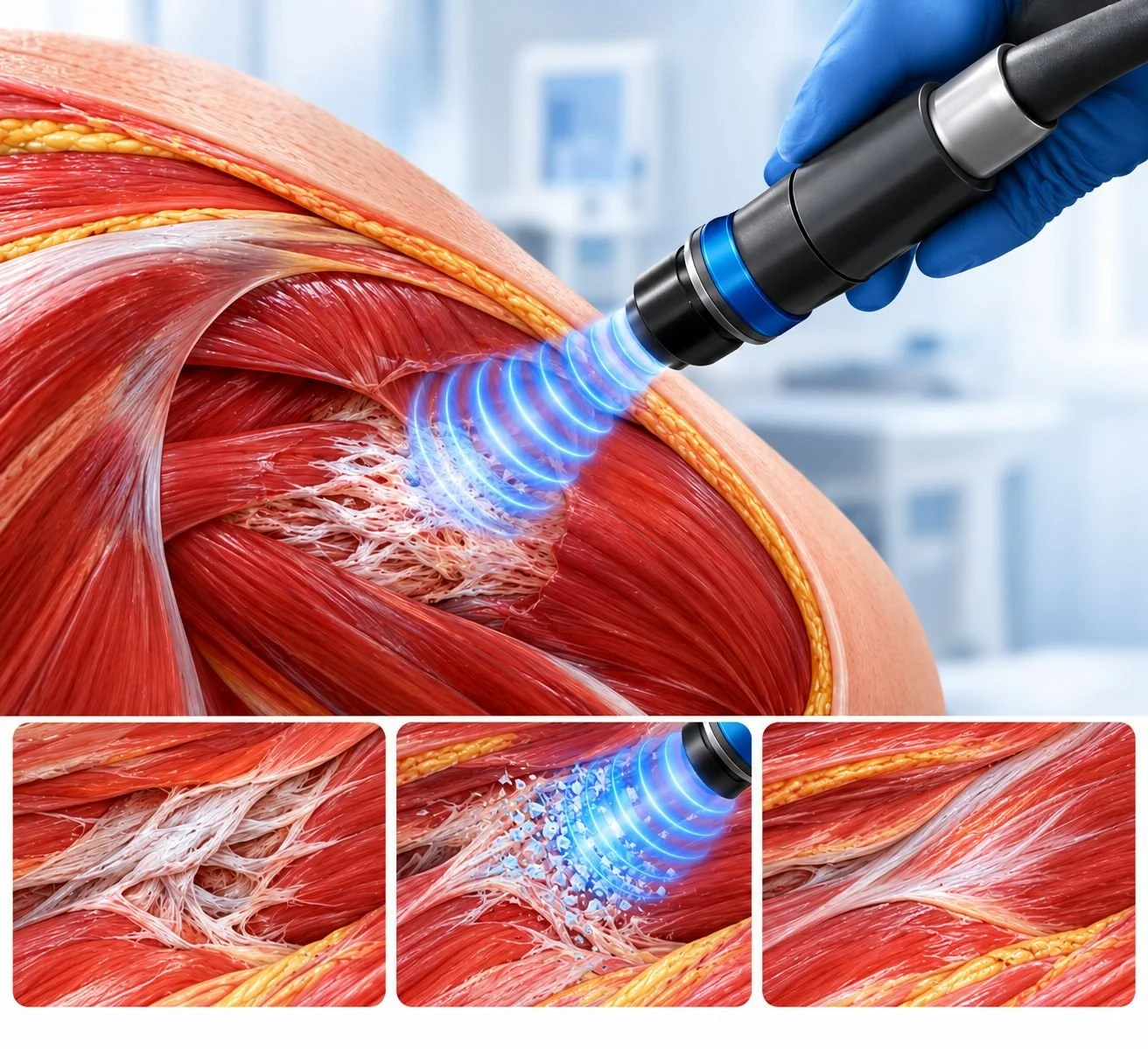
Scar tissue is a normal part of the body's healing process following an injury, surgery or other tissue damage. However, in some people, scar tissue can become thickened, less flexible or adherent to the surrounding tissues. This may contribute to pain, tightness, reduced movement or difficulty performing certain activities.
Physiotherapy can play an important role in helping restore movement and function around scar tissue. Depending on the type, location and maturity of the scar, focused shockwave therapy may also be considered as an additional treatment.
But how does focused shockwave therapy work, and can it really help scar tissue and adhesions?
What is scar tissue?
Scar tissue forms as part of the body's natural healing response following damage to the skin or underlying tissues.
When tissue is injured, the body produces collagen and other connective tissue components to help repair the damaged area. As the scar matures, this tissue normally undergoes a remodelling process.
A healthy, mature scar can become relatively flat, soft and mobile. However, some scars can remain:
Thickened or raised
Firm or fibrotic
Tight or less elastic
Sensitive or painful
Itchy
Adherent to underlying tissues
Restricted in their ability to move relative to surrounding structures
The degree to which a scar causes problems can depend on its size, depth, location, the original injury and how the tissue heals.
Research into physical scar management suggests that appropriately selected physical treatments can improve several scar-related problems, including pain, pliability, thickness and other symptoms.
What is the difference between scar tissue and adhesions?
Although the terms are sometimes used interchangeably, they are not exactly the same.
Scar tissue is the tissue produced as part of the body's healing response.
An adhesion describes tissue that has become abnormally attached to another tissue or structure, restricting normal movement or separation.
A scar can therefore be adherent, but not every scar is significantly adhered.
This distinction matters because treatment needs to target the actual problem rather than simply treating the presence of a scar.
What are scar adhesions?
An adhesion occurs when tissues that would normally glide separately become connected by fibrous tissue.
For example, following surgery, a scar may become attached to the tissues underneath it. This can reduce the normal movement or "glide" between the skin, fascia, muscle and other structures.
You may notice:
A pulling or tethering sensation
Tightness around a scar
Reduced movement of the skin
Pain when stretching or moving the area
Sensitivity when touching the scar
A feeling that the scar is "stuck"
Restriction during certain movements or activities
What is focused shockwave therapy?
Focused shockwave therapy is a non-invasive treatment that uses acoustic pressure waves to deliver mechanical energy to a targeted area of tissue. Unlike radial pressure wave therapy, focused shockwaves can deliver energy to a specific depth beneath the skin.
The treatment is thought to produce biological and mechanical effects within the treated tissues. Research into fibrosis suggests that shockwaves may influence processes involving fibroblasts, collagen organisation, inflammation and tissue remodelling. This is particularly relevant when discussing scar tissue because scar formation involves changes in collagen production and organisation.
Can focused shockwave therapy break down scar tissue?
This is one of the most common questions patients ask.
It is more accurate to say that focused shockwave therapy may influence the biological and mechanical properties of scar tissue and support tissue remodelling, rather than saying that it simply "breaks up" scar tissue.
Laboratory and clinical research suggests that shockwave therapy can influence collagen organisation, fibrosis-related pathways and tissue elasticity. Focused shockwave therapy should not be presented as a guaranteed method of physically destroying or removing scar tissue.
What is the Treatment Protocol for Scar Tissue?
Typical Course
A course of shockwave therapy and physiotherapy for scar tissue usually involves 5 to 8 sessions, spaced about one week apart. Each session lasts 30 minutes per problematic area. The exact number of sessions may vary depending on the severity of the condition and the client’s response to treatment.
Intensity And Frequency
The intensity and frequency of the shockwaves are carefully adjusted based on the client’s pain tolerance and the characteristics of the condition.
Minimal Downtime
Clients can usually resume normal activities immediately after treatment, although they will be advised to avoid strenuous or high-impact activities for a short period if possible.
Post-Treatment Sensation
Some clients may experience mild soreness or swelling in the treated area. This typically resolves within a few days.
Is Focused shockwave painful?
You should feel discomfort during the duration of the treatment, but this should not be intolerable. It is important that you communicate with the clinician during treatment to ensure the speed and power of the shockwaves is adjusted. Please note the area might feel sore for a few days after receiving focused shockwave. It is advised that you limit physical activity until symptoms calm down.
Can I keep taking painkillers?
Focused shockwave is a pro-inflammatory treatment. Inflammation is an important part of the healing process. It sets the scene for healing to occur. Taking non-steroidal anti-inflammatories (NSAIDS) for the following 48 hours is not recommended as it can disrupt this process and reduce the effectiveness of the treatment. I advice paracetamol is taken for pain management if needed after focused shockwave treatment.
The Bottom Line
Scar tissue is a normal part of healing, but in some people it can become painful, stiff or adherent and contribute to reduced movement and function.
Focused shockwave therapy is an emerging treatment option for selected scar-related problems. For this reason, focused shockwave therapy is best considered as part of an individualised physiotherapy programme rather than as a stand-alone treatment.
A comprehensive assessment can help determine whether your symptoms are related to scar tissue, an adhesion, surrounding muscle and soft-tissue restriction, nerve sensitivity or another underlying problem.
If you have a painful, tight or restricted scar that is affecting your movement or function, book an assessment to discuss whether focused shockwave therapy and physiotherapy may be appropriate for you.
