
Calcific Tendonitis
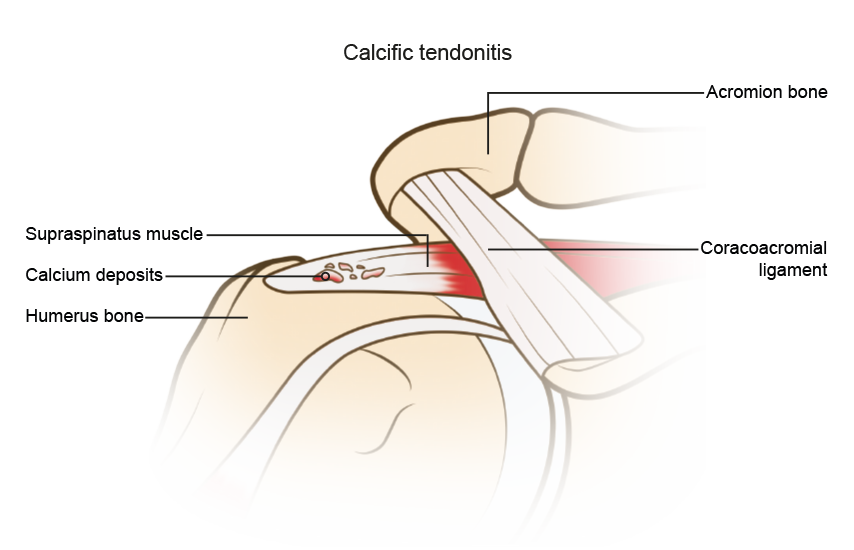
In the UK, calcific tendinopathy (predominantly affecting the shoulder's rotator cuff) affects roughly 2.7% to 10.3% of the general adult population. Calcific tendonitis happens when calcium deposits build up within the tendon. This causes severe pain, limiting your movement and making daily activities difficult to complete. Not all deposits require treatment; up to a fifth of calcific cases remain completely asymptomatic.
What are the common signs and symptoms?
Shoulder pain – this may extend down to your upper arm
Shoulder stiffness
Restricted movement of the shoulder
Sleep disturbance
The symptoms vary significantly from person to person. They may come and go or be more intense and continuous.
The calcium deposits may also reduce the space between structures in the shoulder, leading to a condition called subacromial impingement. This causes pain that worsens when you lift your arm above your head.
Cause and Risk Factors?
Calcific tendonitis is a build-up of calcium within the rotator cuff tendons, specifically the supraspinatus and infraspinatus tendons.
Although it is not clear why this happens, multiple factors put you at risk of developing the condition, such as:
Age 30 – 50
Being female
Sedentary lifestyle
What are my treatment options?
Pain relief – anti-inflammatory medication is usually recommended
Physiotherapy - primarily focuses on reducing pain, preventing adhesive capsulitis, and restoring full range of motion and strength
Focused Shockwave therapy - uses high-energy acoustic waves that penetrate deep into the tissue to target and break apart calcium deposits, stimulate blood flow, and prompt the body to naturally reabsorb the calcium
Steroid injection
Surgery
How many sessions of Focused Shockwave therapy do I need?
Research suggests three sessions spaced one week apart. Sessions can be increased to 6 if clinically appropriate. This will largely be dependent on the success of the initial shockwave treatments. Shockwave treatment can be uncomfortable. For the most effective treatment, the highest possible dose of shockwave tolerated by the patient should be applied.
Can I keep taking painkillers?
Focused shockwave is a pro-inflammatory treatment. Inflammation is an important part of the healing process. It sets the scene for healing to occur. Taking non-steroidal anti-inflammatories (NSAIDS) for the following 48 hours is not recommended as it can disrupt this process and reduce the effectiveness of the treatment. I advice paracetamol is taken for pain management if needed after focused shockwave treatment.
What is Victor the Physio’s approach to treating Calcific Tendonitis?
My approach to treatment is a loading program to stimulate healing, restore function and build resilience in the affected structures. For more chronic or limiting cases, Focused shockwave therapy can be a treatment option. Focused shockwave therapy directs acoustic energy precisely to the exact depth of the calcium deposit disturbing the calcium buildup.
