
Achilles Tendinopathy
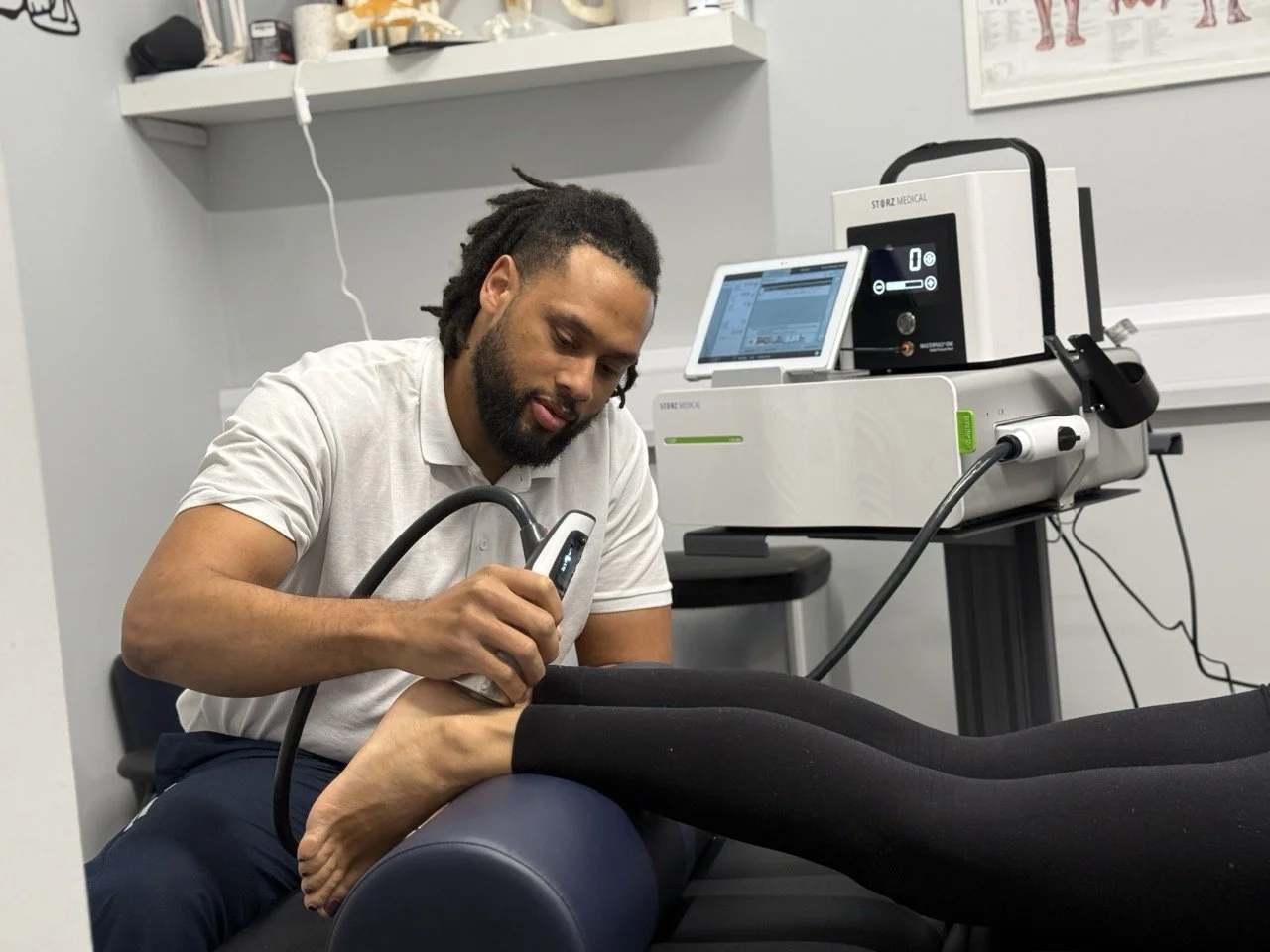
Are you suffering with Achilles tendon pain? This blog aims to explain the condition, dispel common myths associated with the diagnosis, and teach you everything you need to know about managing the condition.
The Achilles is the strongest and thickest tendon in the human body. It can transmit massive forces of up to x10 times your body weight. The primary calf muscles, the gastrocnemius and soleus, attach to the heel bone, via the Achilles tendon.
In the UK, Achilles tendinopathy affects an estimated 150,000 to 300,000 people annually. It is most frequently seen in individuals aged 30 to 59. while the condition is commonly associated with running and jumping sports, roughly 65% of people who present with the condition do not participate in sports, indicating that aging, inactivity, obesity, and comorbidities are major contributing factors. I can personally confirm the significance of these factors as in 2024 i ruptured my Achilles.
What is a Achilles Tendinopathy?
An Achilles Tendinopathy is when there is persistent Achilles tendon pain alongside a loss of function related to mechanical loading. An Achilles tendinopathy is typically categorized based on the location of symptoms as either mid-portion or insertional.
Why did I get a Achilles Tendinopathy?
In short, the intensity, frequency, and volume of load going through the Achilles tendon exceeded your capacity to recover and adapt.
Do I need a scan of my Achilles?
No, What your tendon looks like on imaging is likely irrelevant to the rehab process. When I ruptured my Achilles in 2024, I did not get an investigations. We can tell a lot just through palpation and objective testing.
What are the common symptoms of an Achilles Tendinopathy?
Swollen ankle
Tenderness when you touch your heel or ankle
Pain when walking, running, or putting any weight on your foot
Stiffness
Pain in and around your heel
A creaking sensation or grinding noise when you move your foot
How do I know if am loading the Achilles appropriately?
Pain remains tolerable during exercise. No more than a 5/10 on a discomfort scale
You see an increase in function i.e. able to walk or run further
Please note, If you experience a significant worsening of symptoms the next day. That’s an indication that you’re loading too much and need to back off a bit.
How long does Achilles Tendinopathy take to get better?
The answer is, as always, it depends. Whilst some can see rapid improvement within 3 months, for a lot of those with Achilles tendinopathy, it can take 3-6 months to see improvement, with full pain resolution sometimes taking over 1 year
Do I need Shockwave therapy to help the Achilles Tendon to recover?
If you are struggling to see results, a combination of radial and focused shockwave therapy with a structured rehabilitation program can achieve meaningful improvements in pain, function, and quality of life, especially in those grappling with chronic Achilles tendinopathy. Each modality of shockwave therapy interacts with the tissues differently, influencing neovascularisation, collagen synthesis, and nociceptor modulation. A study has also showed that a combination of the two shockwave therapies offered a solution for individuals who had been unresponsive to radial treatment alone.
What is the protocol for combined shockwave therapy?
Start with Radial SWT to desensitise tendon and surrounding tissues:
2000–2500 impulses, 10–12 Hz, 1.8–3.5 bar
Follow immediately with Focused SWT over the area of maximal pain:
1000–1500 impulses, 4 Hz, 0.10–0.30 mJ/mm²
Session frequency: 3–6 sessions, with at least 7–10 days between treatments.
Post-treatment care: Avoid explosive loads (plyometrics, sprinting) for 48 hours. Initiate heavy slow resistance or heavy isometric training and cross-training as tolerated.
What is Victor the Physio’s approach to treating an Achilles Tendinopathy?
My approach moves beyond just a loading program. It includes a course of combined Radial and Focused shockwave therapy and a load of motivation to keep you compliant with the rehab. I want to build a long-lasting physically resistant Achilles.
